Binaakwe-giizis 🍂
As we welcome October and **Binaakwe-giizis (Falling Leaves Moon)**, we enter a season that reminds us of change, reflection, and the importance of staying connected to one another. As the days grow shorter and the seasons shift, October can offer an opportunity to check in with ourselves, reconnect with community, and consider what we may need to carry forward, and what we may be ready to set down.
October also brings World Mental Health Day on October 10, an opportunity to continue conversations about mental health and well-being. For Indigenous peoples, wellness is not always understood solely at the individual level. Family, community, culture, identity, relationships, land, and connection can all be important parts of well-being. As psychologists, students, educators, and community members, we can continue advocating for approaches to mental health that recognize these relationships and honor the strengths and knowledge within our communities.
This month, we also recognize Indigenous Peoples’ Day on October 12. It is an opportunity to celebrate the histories, cultures, knowledge, resilience, and contemporary contributions of American Indian, Alaska Native, Native Hawaiian, and other Indigenous peoples. It can also be a time for reflection, education, and meaningful conversations about the histories that continue to shape the experiences of Indigenous communities today.
As we move through October, we encourage our relatives to stay connected, make space for rest and reflection, and continue supporting one another. Whether through scholarship, clinical practice, teaching, mentorship, advocacy, or simply checking in with a relative, each of us can contribute to stronger and healthier communities.
**Important News for Psychology Students and Professionals**
On September 24, the National Advisory Committee on Institutional Quality and Integrity (NACIQI) recommended that the U.S. Department of Education suspend the federal recognition of the APA Commission on Accreditation (APA-CoA) for 12 months. This is a recommendation, not a final decision. APA-CoA remains federally recognized while the Department of Education reviews the recommendation, and accreditation activities are continuing as scheduled.
Because a final decision could have implications for psychology training programs, federal funding, and potentially licensure pathways in some states, we encourage students, trainees, educators, and psychologists to stay informed as this situation develops.
Read the latest official update directly from APA-CoA.
Holding Mental Health with Compassion
If you or someone you love is experiencing emotional distress, crisis, or thoughts of self-harm, support is available:
-
United States: Call or text 988 — Suicide & Crisis Lifeline (24/7)
-
Canada: Talk Suicide Canada at 1-833-456-4566 or text 45645 (evenings)
-
StrongHearts Native Helpline (U.S.): 1-844-7NATIVE (762-8483) — confidential, culturally-grounded support for Native and Indigenous peoples affected by violence
-
If you are in immediate danger, please contact local emergency services
If you are outside these regions, we encourage reaching out to local Indigenous organizations, health centers, or community leaders for culturally relevant support.
Psychology, Insurance, and Policy Updates for 2025–2026
Updates: The Centers for Medicare and Medicaid Services (CMS) released the CY2025 Physician Fee Schedule Proposed Rule on July 10, 2024. Find more info: https://www.apaservices.org/practice/reimbursement/government/cms-federal-rule
Medicare changes in 2025. The final rule on the 2025 Medicare physician fee schedule brings some good news for psychologists and aims to increase access to behavioral health services. https://www.apaservices.org/practice/reimbursement/government/2025-medicare-changes
Extensions of Telehealth access options. https://telehealth.hhs.gov/providers/telehealth-policy/telehealth-policy-updates.
But how are the Reservations embracing digital sovereignty?
Digital mental health treatment: CMS expanded payment policies for digital mental health treatment devices under codes G0552, G0553, and G0554 for CY 2026.
Mental Health Parity and Addiction Equity Act Final Rules (“Final Rules”) Are Released: Plans and Issuers Must Prepare for January 1, 2025 Effective Date (US). Find more info: https://www.triagehealthlawblog.com/hhs/mental-health-parity-and-addiction-equity-act-final-rules-final-rules-are-released-plans-and-issuers-must-prepare-for-january-1-2025-effective-date-us/ .Mental Health Parity: The 2024 Mental Health Parity final rule had staggered applicability dates beginning in 2025 and 2026, but federal agencies later announced a pause in enforcement of certain new provisions while they reconsider the rule.
OCTOBER RELATIVES' HIGHLIGHTS

We are excited to celebrate Dr. Anna Kawennison Fetter and the publication of her recent article, Perceived Racial Misclassification Among Native American and Alaska Native College Students: Preliminary Evidence for a Culturally Relevant Stressor.
This important research examines racial misclassification as an understudied culturally relevant stressor and its relationship with mental health among Native American and Alaska Native college students.
Congratulations, Dr. Fetter, on this meaningful contribution to the literature! We invite our relatives and colleagues to read and share her work.
(News from Smoke Signals, Spring 2026)

Dr. Art Blume had a book released on March 19th, wrote a chapter in a book, Way to go Dr. Blume!
His new book, Advancing Health Equity and Psychological Wellness in the Shadows of Colonialism: Reflections from Indigenous Psychology (Bloomsbury, 2026), explores health equity and psychological wellness through an Indigenous psychology lens while examining the continuing impacts of colonialism.
This book may be especially valuable for psychologists, counselors, educators, students, researchers, and other professionals working with Indigenous peoples and communities, or anyone interested in culturally responsive psychology, health equity, and decolonizing approaches to psychological practice and research.

Congratulations to Dr. Mark Standing Eagle Baez on the publication of his latest article, Grounding Indigenous Mental Health and Wellness in Clinical Practice: An Indigenous Framework Informed by the Sweetgrass Method!
This important work offers a culturally grounded framework for supporting Indigenous mental health and wellness, centering relationships, cultural continuity, community, and Indigenous ways of knowing.
This is a valuable read for psychologists, counselors, social workers, students, educators, and other behavioral health professionals seeking to strengthen culturally responsive and relational approaches when working with American Indian and Alaska Native individuals and communities.

We are excited to share an upcoming event featuring Dr. White, and to recognize Dr. Joseph P. Gone for bringing together and hosting this important conversation!
We are always proud to see our relatives creating spaces where Indigenous scholarship, perspectives, and knowledge can be shared with broader academic and professional communities.
Harvard Indigenous Health & Well-Being Seminar Series: Clinical Cultural Neuroscience and Indigenous Resilience. We encourage our relatives, colleagues, students, and others interested in Indigenous psychology and wellness to attend and support this important conversation.

SIP RETREAT & CONVENTION 2027
We are celebrating the 40th year anniversary of SIP!!!
Come celebrate with us June of 2027 in person at Utah State Universit in Logan!
For the Convention Official Page Click Here
Save the date and we hope to see you there!
Executive Committee Statement on ICE Enforcement and the Well-Being of Indigenous Communities
The Society of Indian Psychologists’ Executive Committee offers this collective statement in response to recent Immigration and Customs Enforcement (ICE) activities affecting Indigenous communities. Grounded in Indigenous values, ancestral teachings, and ethical psychological practice, this commentary addresses the mental, cultural, and spiritual impacts of enforcement actions on Native peoples, emphasizing sovereignty, historical trauma, and the need for culturally responsive, healing-centered approaches.
THE YEAR 2026


For allies, agencies, organizations, and groups looking to produce a Land
Acknowledgment, we would like to share and amplify existing resources developed by
the Native Governance Center. We would like to urge interested parties to review in its
entirety the Indigenous Land Acknowledgement Guide.
This guide takes you through some steps to developing a thoughtful, respectful, and well-
researched land acknowledgment.
Most importantly, we urge interested folks to take time to review the Beyond Land
Acknowledgement Guide.
This resource outlines some problems with land acknowledgements, including
asking Indigenous collaborators to develop the land acknowledgment, careless or
limited research to inform the statement, and a focus on verbiage and optics rather than
steps towards tangible allyship. This guide then walks readers through developing a
meaningful action plan for Indigenous allyship that moves beyond land
acknowledgment, including a self-assessment and action planning worksheet.
Updated March 27 2025 by Brian McNeill, Ph.D. (Nez Perce and Palouse)
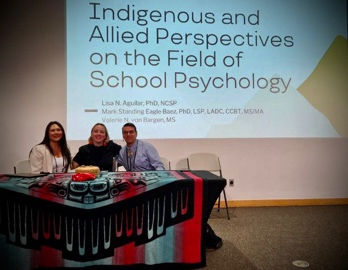
SIP Attends the APA 2025 Convention in Denver!!
 |  |  |  |
|---|---|---|---|
 |  |  |  |
 |  |  |  |
 |  |  |  |
 |